
The cryptocurrency mining industry is undergoing a dramatic transformation as companies search for new revenue streams beyond traditional bitcoin mining. One of the biggest examples of this shift is the recent move by Core Scientific dumps bitcoin to fund AI shift, a development that has sparked widespread debate across the digital asset sector. The company’s decision to sell portions of its bitcoin holdings to accelerate investments in artificial intelligence infrastructure marks a turning point not only for Core Scientific but for the broader crypto mining landscape as well.
For years, bitcoin miners focused almost exclusively on generating profits from digital asset production. However, changing market conditions, rising energy costs, increased competition, and the growing demand for AI computing power have encouraged miners to rethink their long-term strategies. As the artificial intelligence boom continues to reshape global technology markets, data centers and high-performance computing facilities are becoming some of the most valuable digital infrastructure assets in the world.
Core Scientific’s pivot demonstrates how crypto mining companies are increasingly leveraging their existing power infrastructure, cooling systems, and data center expertise to enter the AI sector. The company’s move to liquidate bitcoin assets in order to fund artificial intelligence expansion reflects a broader trend where mining firms are evolving into diversified technology infrastructure providers.
The announcement has generated significant attention among investors, crypto analysts, and AI industry observers. Some see the decision as a visionary strategy designed to future-proof the company in an increasingly competitive market. Others worry that reducing bitcoin exposure could weaken the firm’s long-term position if cryptocurrency prices continue to rise. Regardless of perspective, the Core Scientific bitcoin sale highlights the growing intersection between blockchain technology and artificial intelligence.
The Growing Pressure on Bitcoin Mining Companies
Bitcoin mining has always been a capital-intensive industry, but recent years have introduced even greater financial challenges. Mining firms must constantly upgrade hardware, manage electricity expenses, and maintain operational efficiency to remain profitable. At the same time, bitcoin price volatility can create unpredictable revenue streams that complicate long-term planning.
The latest halving events have intensified pressure on miners because mining rewards are reduced periodically. As mining rewards shrink, companies must either improve operational efficiency or find alternative sources of income. This economic reality has encouraged many mining firms to explore opportunities outside pure cryptocurrency mining.
For Core Scientific, the decision to fund AI infrastructure through bitcoin sales reflects these industry pressures. Rather than relying solely on mining revenue, the company is repositioning itself within the rapidly expanding artificial intelligence ecosystem. This strategy could help stabilize earnings while opening access to entirely new markets.
The rise of AI technologies such as machine learning, generative AI, and large language models has dramatically increased demand for high-performance computing facilities. Tech companies require enormous amounts of processing power to train AI systems, and data centers with robust energy infrastructure are in particularly high demand. Crypto mining companies already possess many of these assets, making them natural candidates for AI expansion.
Why Core Scientific Is Shifting Toward AI
The decision behind the Core Scientific AI strategy is largely driven by economics. Artificial intelligence infrastructure currently offers potentially higher and more stable revenue opportunities compared to traditional bitcoin mining. Demand for AI computing resources continues to grow at an extraordinary pace as companies across industries invest heavily in automation and machine learning capabilities.
Unlike cryptocurrency markets, which can experience sudden downturns, AI infrastructure contracts often provide predictable long-term income streams. This financial stability is highly attractive for companies seeking to reduce dependence on volatile digital asset markets.
Core Scientific already operates large-scale data centers equipped with advanced cooling systems and substantial electrical capacity. These facilities are ideal for both bitcoin mining and AI computing workloads. By repurposing portions of its infrastructure for artificial intelligence applications, the company can maximize asset utilization while expanding into a booming sector.
Another factor influencing the transition is investor sentiment. Financial markets have increasingly rewarded companies connected to AI growth. Firms associated with artificial intelligence infrastructure often receive stronger valuations than pure-play crypto miners. Core Scientific’s shift toward AI may therefore improve investor confidence and attract new institutional interest.
The company’s strategy also reflects a broader convergence between blockchain and artificial intelligence technologies. Both industries rely heavily on computational power and advanced infrastructure. As a result, many crypto mining firms are discovering that their operational expertise can be applied effectively within AI ecosystems.
The Significance of Selling Bitcoin Holdings
The decision to sell bitcoin reserves carries symbolic and financial importance. Traditionally, many mining companies accumulated bitcoin as a long-term treasury asset, betting on future price appreciation. Selling those holdings to finance AI infrastructure signals a strategic reallocation of capital toward a different growth narrative.
For some investors, the move raises concerns about confidence in bitcoin’s future upside potential. However, the decision does not necessarily indicate bearish sentiment toward cryptocurrency. Instead, it may reflect a pragmatic assessment of where near-term growth opportunities are strongest.
By converting bitcoin holdings into funding for AI projects, Core Scientific gains liquidity without relying entirely on debt financing or equity dilution. This can help maintain financial flexibility while supporting expansion initiatives. In a highly competitive industry, having access to capital is essential for maintaining technological leadership.
The bitcoin liquidation also demonstrates how digital assets can function as strategic balance sheet tools. During bullish market periods, mining firms may accumulate substantial cryptocurrency reserves. Later, those assets can be monetized to support diversification or infrastructure development.
This approach illustrates the evolving financial sophistication of major crypto mining companies. Rather than simply mining and holding bitcoin indefinitely, firms are increasingly managing digital assets dynamically to support broader corporate objectives.
How AI Infrastructure Is Reshaping Data Centers
Artificial intelligence has transformed data center economics in profound ways. Traditional cloud computing already required large-scale infrastructure, but AI workloads demand even greater computational intensity. Training advanced AI models consumes vast amounts of electricity and requires specialized hardware such as GPUs and accelerated computing systems.
Data centers capable of supporting these requirements have become highly valuable assets. Companies with existing power access and cooling capabilities are now positioned to capitalize on the AI boom. This dynamic explains why many bitcoin miners are pivoting toward high-performance computing.
Core Scientific’s AI expansion reflects this industry-wide evolution. The company’s facilities already contain much of the infrastructure necessary for large-scale computing operations. Transitioning part of that infrastructure toward AI hosting services could generate substantial new revenue opportunities.
The convergence between crypto mining and AI also highlights the growing importance of energy infrastructure in the digital economy. Both industries compete for access to affordable electricity and scalable computing capacity. Companies capable of managing these resources efficiently may gain significant competitive advantages.
As AI adoption accelerates globally, demand for computing infrastructure is expected to continue rising. This trend may encourage even more mining firms to diversify into artificial intelligence services over the coming years.
Investor Reactions to the Core Scientific AI Shift
Market reactions to the Core Scientific bitcoin sale have been mixed but highly engaged. Some investors view the company’s AI pivot as a forward-thinking strategy aligned with emerging technology trends. These supporters argue that artificial intelligence represents one of the most promising growth sectors in the global economy.
Others remain cautious, particularly among traditional crypto investors who prefer companies to maintain strong bitcoin exposure. Critics worry that shifting resources away from mining could reduce long-term upside potential if bitcoin prices surge significantly in future market cycles.
Despite differing opinions, most analysts agree that diversification may improve operational resilience. The cryptocurrency industry has historically experienced extreme volatility, and companies dependent on a single revenue stream often face significant financial risk during downturns.
By entering AI infrastructure markets, Core Scientific may reduce exposure to fluctuations in mining profitability. This diversification could help stabilize revenue while enhancing long-term sustainability.
Institutional investors have shown growing interest in companies positioned at the intersection of AI and digital infrastructure. As a result, the market may ultimately reward firms capable of adapting successfully to evolving technology trends.
The Broader Trend Among Crypto Mining Firms
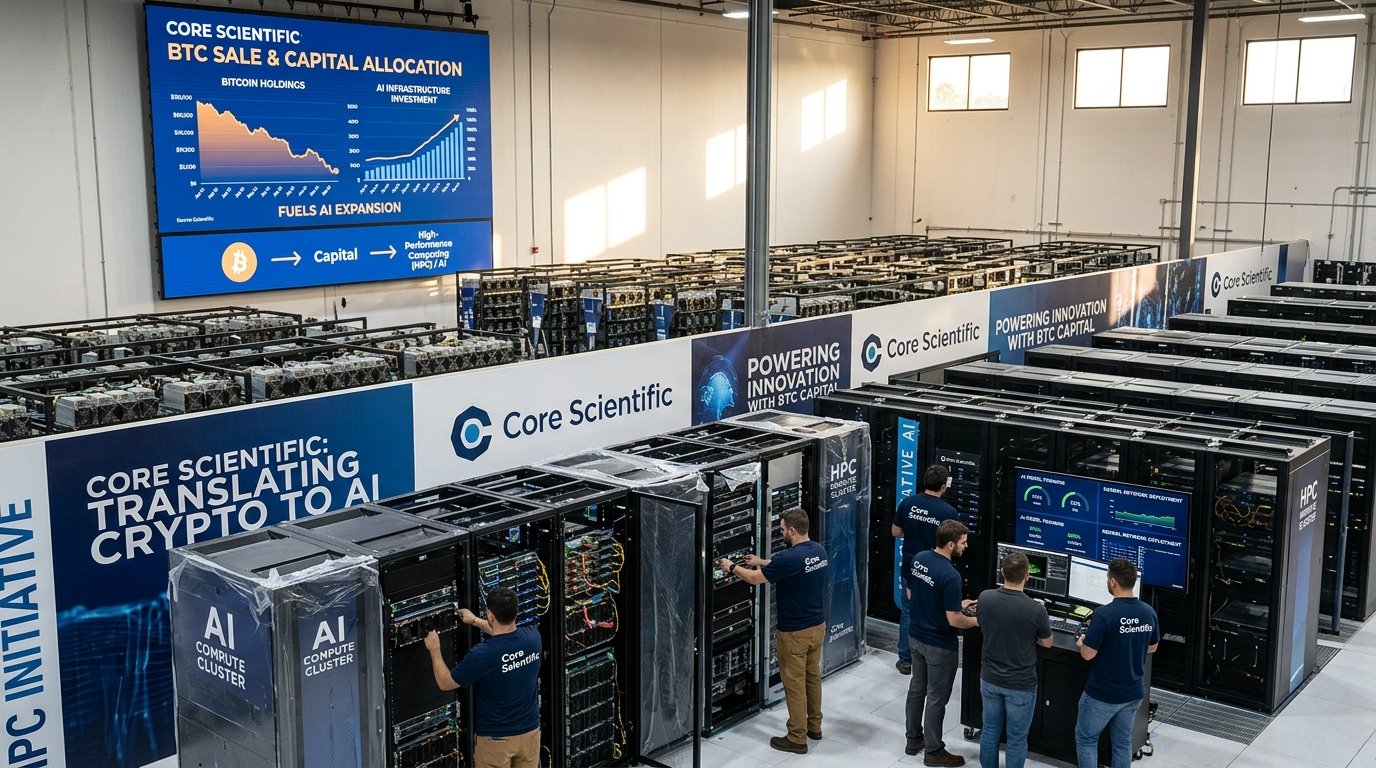 Core Scientific is not alone in exploring artificial intelligence opportunities. Across the crypto mining industry, companies are increasingly repositioning themselves as broader infrastructure providers rather than purely mining-focused businesses.
Several miners have announced partnerships related to AI hosting, cloud computing, and high-performance computing services. This shift reflects recognition that mining infrastructure can support multiple types of computational workloads.
The overlap between AI and bitcoin mining is particularly significant because both sectors require similar operational capabilities. Large-scale facilities, cooling systems, network connectivity, and energy management expertise are essential for success in both industries.
As competition intensifies in bitcoin mining, diversification may become necessary for survival. AI infrastructure offers an attractive avenue because global demand continues expanding rapidly. Companies that can successfully integrate AI services into existing operations may gain substantial financial advantages.
This transformation also signals maturation within the crypto industry. Early mining firms often focused narrowly on cryptocurrency production, but modern operators increasingly resemble sophisticated technology infrastructure companies with diversified business models.
Potential Risks of the AI Pivot
Although the Core Scientific AI strategy offers promising opportunities, it also involves significant risks. Artificial intelligence infrastructure requires major capital investment, and competition in the sector is growing quickly. Large technology companies already dominate many segments of the AI computing market.
Successfully transitioning from crypto mining to AI hosting also requires operational adjustments. Managing AI workloads differs from traditional mining operations, particularly regarding hardware optimization and customer relationships.
There is also the risk that bitcoin prices could rise substantially after the company sells its holdings. In that scenario, critics may argue that retaining bitcoin reserves would have generated greater long-term returns.
Regulatory uncertainty presents another challenge. Both cryptocurrency and artificial intelligence industries face evolving legal frameworks that could impact operational costs or business strategies in the future.
Additionally, AI demand growth may eventually slow if market saturation occurs or technological advancements reduce computing requirements. Companies investing heavily in infrastructure must carefully manage these long-term uncertainties.
The Relationship Between AI and Cryptocurrency
The growing relationship between artificial intelligence and cryptocurrency is becoming increasingly important across technology markets. While the two industries were once viewed separately, they now share overlapping infrastructure needs and investment trends.
Blockchain networks and AI systems both rely on large-scale computing power. This common requirement has encouraged collaboration between sectors and created new business opportunities for infrastructure providers.
Some analysts believe AI could eventually improve blockchain technology through enhanced automation, fraud detection, and smart contract optimization. Others predict that decentralized AI networks may emerge using blockchain-based incentive systems.
Core Scientific’s transition illustrates how these industries are converging operationally. Crypto mining infrastructure can often be adapted for AI workloads, enabling companies to diversify efficiently without starting entirely from scratch.
This convergence may ultimately create hybrid technology ecosystems where blockchain and AI services operate alongside one another within shared infrastructure environments.
What This Means for the Future of Bitcoin Mining
The Core Scientific bitcoin sale may represent a broader turning point for the mining industry. As profitability pressures continue mounting, miners may increasingly diversify into adjacent technology sectors rather than relying solely on digital asset production.
Artificial intelligence infrastructure currently appears to be one of the most attractive opportunities because of explosive demand growth and strong investor interest. However, other diversification paths may also emerge, including cloud computing, energy management services, and decentralized computing networks.
Bitcoin mining itself is unlikely to disappear, particularly if cryptocurrency adoption continues expanding globally. However, the industry may evolve into a more diversified and infrastructure-focused sector over time.
Companies capable of balancing mining operations with AI services could become particularly resilient during future market cycles. Diversification may allow firms to maintain profitability even during periods of weak cryptocurrency prices.
Core Scientific’s strategy therefore serves as an important case study for how crypto infrastructure companies may adapt to changing technological and economic conditions.
Conclusion
The decision by Core Scientific to dump bitcoin in order to fund an AI shift represents one of the most significant strategic transformations currently unfolding in the cryptocurrency mining industry. The company’s move reflects changing market realities, growing demand for artificial intelligence infrastructure, and the increasing convergence between blockchain technology and high-performance computing.
While opinions remain divided regarding the wisdom of reducing bitcoin exposure, the broader logic behind the transition is clear. Artificial intelligence has become one of the fastest-growing sectors in the global economy, and companies with existing data center infrastructure are uniquely positioned to benefit from this trend.
Core Scientific’s AI expansion demonstrates how mining firms are evolving beyond traditional cryptocurrency production into diversified digital infrastructure providers. This transformation may ultimately redefine the future of the mining industry itself.
As AI adoption accelerates and computational demand continues rising, the relationship between cryptocurrency infrastructure and artificial intelligence is likely to grow even stronger. Whether Core Scientific’s strategy proves visionary or premature will depend on future market developments, but its decision has already become a defining moment in the evolution of crypto mining.
FAQs
Q. Why did Core Scientific sell bitcoin holdings?
Core Scientific sold portions of its bitcoin reserves to generate capital for expanding into artificial intelligence infrastructure and high-performance computing services.
Q. How does AI infrastructure relate to bitcoin mining?
Both industries require significant computing power, energy resources, cooling systems, and large-scale data centers, making mining facilities suitable for AI workloads.
Q. Is Core Scientific abandoning bitcoin mining completely?
No, the company is not completely exiting bitcoin mining. Instead, it is diversifying operations by adding AI infrastructure services alongside existing mining activities.
Q. Why are crypto mining companies interested in AI?
Artificial intelligence offers potentially more stable and profitable revenue streams compared to the volatility of cryptocurrency mining markets.
Q. Could other mining companies follow the same strategy?
Yes, many mining firms are already exploring AI hosting and high-performance computing opportunities as part of broader diversification efforts.
Leave a Reply